
The Retention Graph Reality
My audience retention graphs used to flatline precisely at the forty-five-second mark of every single upload. Viewers simply clicked away because my pacing completely fell apart after the initial opening hook. Staring at a blinking cursor for three hours usually results in a rambling, unstructured monologue that actively pushes your audience toward a competitor's channel.
Transitioning from random brainstorming to structured narrative design completely reversed my channel's trajectory overnight. You cannot rely on raw charisma when the platform heavily rewards tight, information-dense storytelling.
When evaluating the best AI script writing tools for YouTube creators, your choice depends entirely on your specific content format. Claude stands out as the undisputed champion for long-form narrative coherence and educational pacing. ChatGPT excels at generating aggressive hooks and brainstorming alternate angles, while Jasper and VidIQ provide the strongest specialized workflows if you need strict brand guidelines or heavy search optimization.
Audience retention data tells a brutal story about modern attention spans. The algorithm actively punishes videos that fail to deliver immediate, concrete value within the first thirty seconds. When a viewer clicks your thumbnail, they silently demand an immediate answer to their problem or instant entertainment.
Writing a script that satisfies this psychological urgency requires a highly specific structural rhythm. Most channels fail because they treat scriptwriting exactly like writing a high school essay. Text-heavy documents rely on complex transitions and passive phrasing that sound incredibly awkward when spoken aloud to a camera lens.
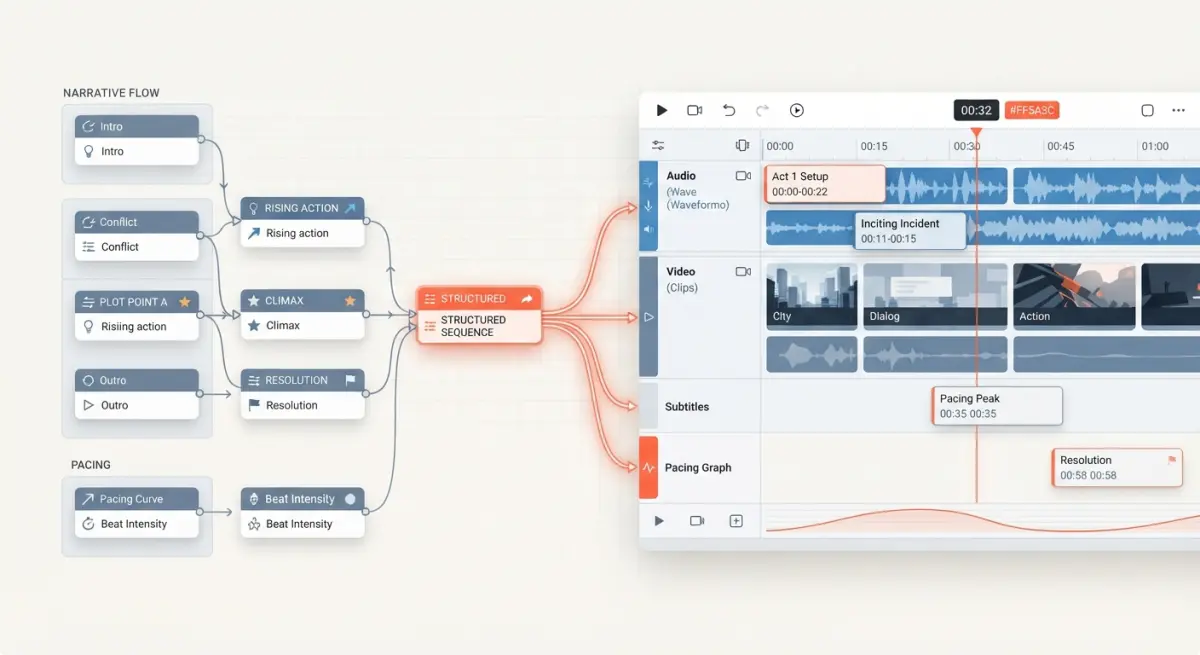
The best AI script writing tools for YouTube creators solve this specific translation problem by applying mathematical logic to your narrative flow. They intuitively understand how to introduce a conflict, supply compelling evidence, and delay the final payoff until the closing seconds of the video.
How Artificial Intelligence Actually Structures Narrative Pacing
Modern Large Language Models process narrative arcs by analyzing millions of successful video transcripts across every imaginable niche. They break down the underlying mathematical relationship between the opening hook, the core educational content, and the eventual audience drop-off rate.
When you ask these engines for a YouTube script, they automatically map out precise timestamps and B-roll visual cues alongside your dialogue.

You receive a complete production blueprint instead of just a generic block of plain text. The system calculates the average spoken words-per-minute to ensure your content fits your target duration exactly. This prevents you from recording a forty-minute rambling session that you later have to heavily butcher in the editing room.
These systems also excel at building inverted pyramids of information. They structure paragraphs to deliver the most compelling, high-retention information upfront rather than hiding it behind long, drawn-out introductions. The AI acts as a ruthless editor, instantly stripping away tangent thoughts that do not explicitly serve your main narrative arc.
Claude vs ChatGPT: Analyzing Output Texture
The texture of the generated text differs wildly between the major generative platforms. ChatGPT tends to write with extremely high enthusiasm, frequently utilizing exclamation points, rhetorical questions, and dramatic adjectives.
This highly energetic tone works beautifully for fast-paced tech reviews, daily vlogs, or entertainment-focused gaming channels. However, it requires heavy manual editing if you operate a serious true crime channel or a highly technical documentary series.
Claude takes a much more measured, academic approach to its sentence construction. It builds arguments carefully across multiple paragraphs, layering verifiable facts and concrete examples in a way that feels highly authoritative. The model rarely relies on cheap clickbait tactics to maintain viewer attention, preferring to use genuine intellectual curiosity as the driving force.
When you use Claude for a twenty-minute video essay, the final conclusion actually feels earned. It deliberately references arguments established in the opening minutes, creating a highly satisfying narrative loop for the viewer. Most competing models simply summarize the entire video in basic bullet points at the end, which actively causes viewers to abandon the video immediately before your final call to action.
Purpose-Built Search Optimization Platforms
General-purpose language models know exactly how to write beautiful prose, but they do not naturally understand YouTube's underlying search algorithm. Purpose-built platforms bridge this massive technical gap by combining active keyword research directly with the writing interface. You simply enter a broad topic, and the system instantly analyzes what titles are currently performing exceptionally well in your specific micro-niche.
The software then generates a complete outline fully optimized for those exact high-volume search terms. It ensures that your spoken dialogue naturally includes the specific phrases that YouTube's automatic transcription software scans for during the upload process. This aggressive dual approach helps your video rank significantly higher in search results while simultaneously keeping the viewer highly engaged.
You essentially get a growth strategist and a professional copywriter housed entirely within the exact same dashboard. For solo creators who lack the time to manually research keyword volume metrics, these highly specialized platforms provide an unbelievable competitive advantage.
Pre-Production Workflows That Command Attention
Before you even open a browser tab to start writing, you need a solid conceptual framework mapped out. The absolute most advanced language model on the market cannot save a fundamentally boring video premise. You must validate your core idea by actively analyzing whether there is genuine audience demand for the specific topic.
Once you confirm the baseline demand, utilize the AI engine to generate ten different, highly distinct title and thumbnail concepts. The final script must be written specifically to fulfill the exact promise made by your chosen thumbnail. If the thumbnail promises a shocking financial revelation, the AI must weave that specific tension throughout the entire first half of the resulting script.
I constantly prompt the generative engine to write the video in distinct structural blocks rather than a single continuous stream. The first block focuses strictly on the opening hook and the core value proposition. The second block contains the actual educational content, broken down into easily scannable chapters. The final block focuses entirely on creating a smooth, natural transition into a relevant end-screen video to maximize your binge-watching sessions.
Managing this complex multi-step process requires strict discipline, but it heavily separates professionals from amateurs. If your production pipeline constantly feels messy, reviewing Descript Alternatives helps you discover environments that combine scripting, transcription, and timeline editing into one unified dashboard. Audio-first creators should also investigate the Best AI Tools for Podcast Editing to ensure their spoken delivery matches the high quality of their newly generated scripts.
DIY Prompt Engineering Frameworks
You absolutely do not need to pay for expensive enterprise software to achieve professional broadcasting results. The free tiers of these major platforms produce incredible outlines if you understand exactly how to communicate with them. The true secret lies entirely in how you structure your initial engineering prompt.
- Give the AI a highly specific creator persona and define the target audience demographics before asking for any actual content.
- Demand a specific psychological hook format, such as starting with a jarring statistic or a highly contrarian statement.
- Force the model to include dedicated section headers that you can seamlessly convert into YouTube chapters later.
- Instruct the engine to write exclusively in short, punchy sentences while entirely avoiding the passive voice.
- Ask the AI to aggressively flag any factual claims in the draft so you can manually verify them against primary sources.
Applying this strict framework automatically reduces your editing time by a massive margin. You completely avoid the generic, robotic fluff that severely plagues lazy AI outputs across the internet.
Side-by-Side Architectural Comparison
When you break down the technical specifications, the intended user base for each tool becomes incredibly obvious.
| Platform | Primary Strength | Ideal Creator Persona | Pricing Structure |
|---|---|---|---|
| Claude | Long-form coherence | Essayists & Educators | Freemium / Paid Pro |
| ChatGPT | Brainstorming & Hooks | Vlogs & Tech Reviews | Freemium / Paid Plus |
| Gemini | Live web research | News & Finance | Free / Workspace |
| Jasper AI | Brand consistency | Marketing Teams | Premium Subscription |
| vidIQ | SEO integration | Growth-focused Solo | Freemium / Upgrades |
If you pair exceptionally strong writing with highly aggressive visual pacing, your retention metrics will absolutely skyrocket. A solid understanding of the Best AI Tools for YouTube Video Editing directly ensures your final visual cut perfectly matches the intense energy of your new scripts.
Sometimes, the smartest scripting strategy involves extracting your best narratives directly from long, unscripted recording sessions. Reviewing an OpusClip Review AI Video Clipping Tool demonstrates exactly how automated curation systems identify the most engaging spoken moments without requiring manual searching.
Protecting Your Authentic Voice
Never copy and paste a generated draft directly into your studio teleprompter. You always have to actively mold the raw output to fit your natural, unique speaking cadence.
- ✅ Read the entire generated draft aloud while standing up to identify any specific phrases that cause you to stumble.
- ✅ Delete any sentence that simply restates information you already provided clearly in the previous paragraph.
- ✅ Manually insert two or three personal, highly specific anecdotes that the artificial intelligence could never possibly invent.
- ✅ Verify every single number, date, and historical statistic against a highly reliable primary source document.
- ✅ Check that your final call-to-action actually aligns with the initial promise made in your opening hook.
My biggest workflow breakthrough happened when I permanently stopped asking the AI to write the entire script at once. I now generate the outline first, approve the high-level structure, and then ask the model to flesh out one specific section at a time. This micro-prompting approach gives me tight control over the narrative flow and completely eliminates the robotic, predictable transitions that viewers immediately recognize.
Sometimes, watching a successful creator break down their exact prompting sequence explains the nuanced process much better than reading about it.
Once you nail the precise spoken words, you might want to automate the actual vocal delivery entirely. Many faceless channel operators read an ElevenLabs Voice Cloning/Dubbing Review to find synthetic narrators that sound completely human. Combine that cutting-edge technology with a platform found in a CapCut vs Descript Video Editor Comparison to edit your generated text directly on a visual timeline.



Comments (0)
No comments yet. Be the first!
Leave a Comment