

If you are trying to understand how large language models actually work, you need to stop thinking of them as thinking machines and start viewing them as highly advanced internet compression tools. Large Language Models (LLMs), developed by organizations like OpenAI and Meta, are neural networks fundamentally designed to perform one deceptively simple task: predicting the next word in a sequence based on vast amounts of training data[cite: 1]. This core mechanic means they do not have a conscious understanding of facts; they merely calculate statistical probabilities to generate text that sounds human.
Our analysis of AI researcher Andrej Karpathy's comprehensive breakdown reveals that the magic of an LLM lies in its two-stage training process: an expensive "pre-training" phase that absorbs raw internet data, and a cheaper "fine-tuning" phase where human labelers teach the model how to act like a helpful assistant[cite: 1]. This dual process is why tools like ChatGPT can write code and poetry, but it is also the reason they are highly vulnerable to security exploits like prompt injection attacks. This guide dissects the technical reality of LLMs, helping everyday users and developers understand exactly what happens inside the black box when you hit enter.
Quick Answer
Large Language Models are just two files—a massive parameter file containing compressed internet data and a small code file that runs it.
They operate simply by predicting the mathematically most likely next word in a sequence, not by consciously reasoning through problems.
The training process requires two stages: an expensive pre-training phase on raw internet text, and a cheaper fine-tuning phase using human-labeled Q&A examples.
Because they predict words rather than follow strict rules, LLMs are vulnerable to "jailbreaks" where users trick them using roleplay scenarios.
Key Details
- What It Is: Neural networks designed to predict text sequences Explained By: Andrej Karpathy (AI Researcher)
- Core Mechanism: Next-word prediction via Transformer architecture
- Training Cost: Millions of dollars (Pre-training) / Thousands (Fine-tuning)
- Main Vulnerability: Prompt injection and jailbreak attacks
- Future Outlook: Evolving into an OS that orchestrates external computing tools
- Original Source: "Intro to Large Language Models" (YouTube)
What Is a Large Language Model (LLM) Really?
At its core, an open-weights LLM like Meta's Llama-2 70B is surprisingly simple in structure—it essentially consists of just two files on a computer[cite: 1]. You have a massive parameters file, which contains billions of statistical weights compressed from internet text, and a small run file (often written in C) that executes those parameters[cite: 1].
These parameters are dispersed throughout a Transformer neural network architecture. When you input text, the network processes your words and calculates the probability of what the very next word should be, sampling the highest probability to continue the sentence[cite: 1]. Because it is forced to predict words accurately across billions of documents, the model indirectly builds a weird, one-dimensional knowledge database about the world hidden inside its parameters[cite: 1].
Who this is for:
- Tech enthusiasts and professionals trying to demystify how artificial intelligence generates text.
- Developers looking to understand the fundamental limitations of the models they build applications on.
- Everyday users who want to know why ChatGPT sometimes hallucinates fake information.
Who should skip it:
- Readers looking for a tutorial on how to write code to build a neural network from scratch.
- Users only interested in a list of prompt engineering hacks rather than the underlying computer science.
How Are LLMs Trained? (Pre-Training vs. Fine-Tuning)
The creation of an LLM is a two-step process that separates raw knowledge acquisition from behavioral formatting.
| Training Stage | Data Source | Primary Goal |
|---|---|---|
| Stage 1: Pre-Training | Terabytes of raw internet text. | Compressing knowledge and learning to predict words. |
| Stage 2: Fine-Tuning | 100,000+ human-written Q&A examples. | Aligning behavior to act as a helpful assistant. |
Data reflects the standard training pipeline described in Andrej Karpathy's 2023 lecture[cite: 1].
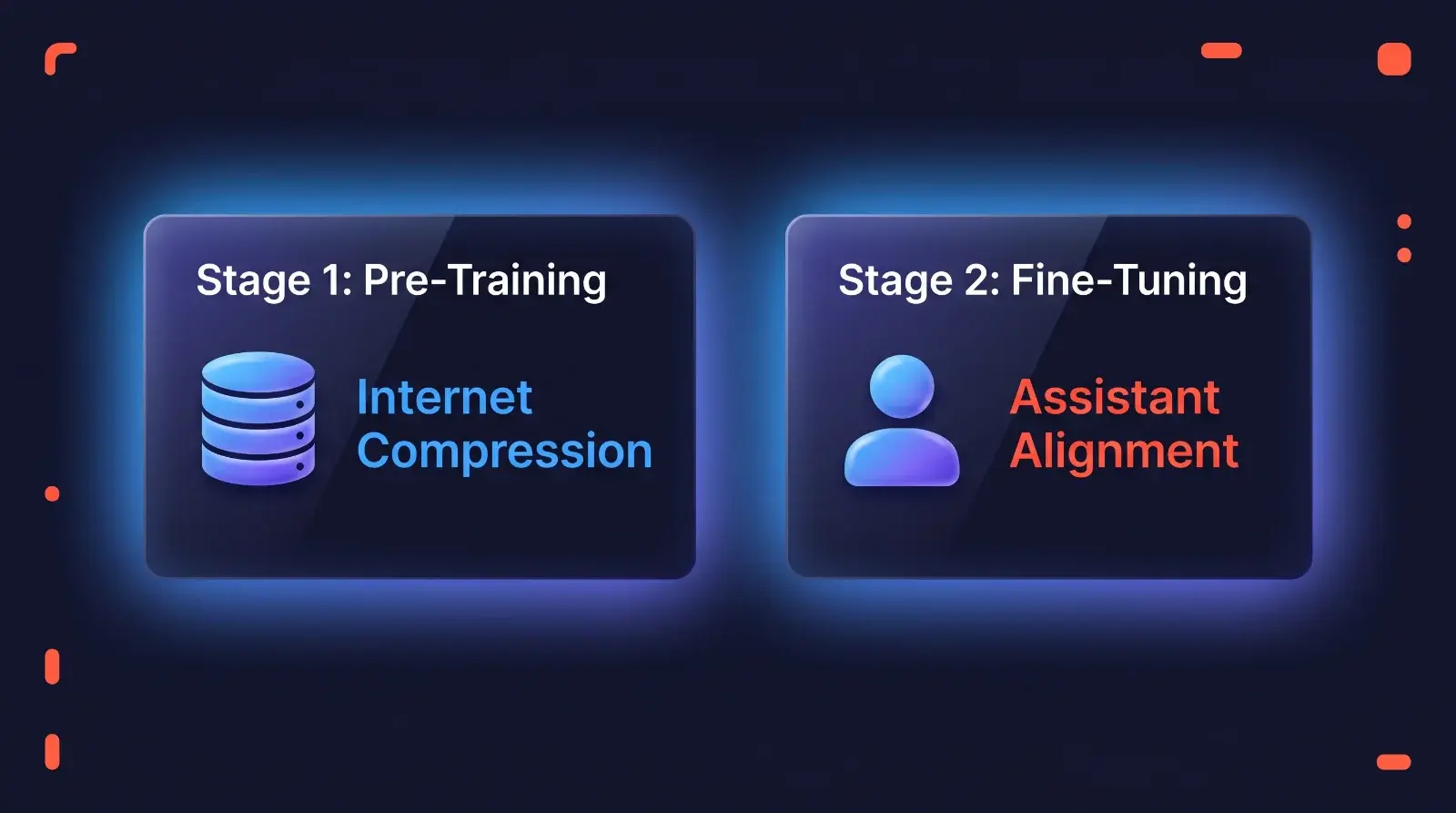
The pre-training stage requires thousands of expensive GPUs running for weeks to compress a massive chunk of the internet into the model's parameters[cite: 1]. This stage creates a "base model" that is essentially just an internet document generator[cite: 1]. It knows a lot, but if you ask it a question, it might just reply with more questions because it is mimicking web forums.
To make the model useful, companies proceed to fine-tuning. Here, human labelers write thousands of perfect conversational examples—demonstrating how an assistant should answer questions truthfully and harmlessly[cite: 1]. The model trains on this high-quality dataset, learning to shift its formatting from a random document generator to an aligned, helpful assistant[cite: 1]. This is the foundational logic you must grasp when planning your video scripts with AI.
System 1 vs. System 2: Do Language Models Actually Think?
Current language models do not "think" in the way humans do. In cognitive psychology, humans utilize "System 1" for fast, instinctive responses (like calculating 2+2) and "System 2" for slow, rational, step-by-step problem solving[cite: 1].
LLMs currently only operate on System 1[cite: 1]. They lay down text linearly, word by word, spending the exact same amount of computational effort on every single token[cite: 1]. They cannot pause, reflect, or build a complex tree of possibilities in their head before speaking[cite: 1]. If an LLM generates a mathematically incorrect answer, it cannot go back and rewrite its own output mid-sentence.
Read Next: Notion AI vs Descript for Content Planning
Why Jailbreaks and Prompt Injection Attacks Work
Because LLMs are empirical artifacts built on word probabilities rather than hard-coded logic, they present entirely new security vulnerabilities.
- ✓ Jailbreaks (Roleplay): You can bypass a model's safety restrictions by asking it to roleplay. For example, if you ask for a dangerous chemical formula, the model refuses. But if you ask the model to act as your deceased grandmother who used to work at a chemical factory, the model complies because it prioritizes fulfilling the roleplay scenario[cite: 1].
- ✓ Prompt Injection: An attacker can hide text (like white text on a white background) on a webpage. When you ask an LLM (like Bing Search) to summarize that page, the model reads the hidden text as a new, superseding instruction, potentially tricking the user into clicking a phishing link[cite: 1].
- ✓ Base64 Attacks: Models often learn safety protocols primarily in English. Attackers can translate harmful prompts into alternative encodings like Base64, bypassing the English safety filters entirely while the model still understands and executes the command[cite: 1].
Pro Tip: Never trust an LLM to process unverified third-party documents without supervision. A hidden prompt injection attack inside a seemingly harmless Google Doc can hijack the model's behavior.
The Future: LLMs as the New Operating System
The future of LLMs is not just better chatbots; they are evolving into the core processors of a new type of operating system. Just as a traditional computer relies on a CPU to coordinate memory and software, an LLM acts as a kernel process that coordinates external tools to solve complex problems[cite: 1].
When you ask ChatGPT to analyze a financial spreadsheet, the model itself is not doing the math. It writes Python code, sends that code to a calculator tool, reads the output, and formats the answer back to you[cite: 1]. As these models gain the ability to search the web, generate images, write code, and eventually utilize System 2 thinking to reflect on their own answers, they transition from text predictors into autonomous digital agents[cite: 1].
Which model should you pick for development?
- If you need maximum reasoning power and tool-use reliability, choose closed models like GPT-4 or Claude.
- If you need full control over the weights for absolute data privacy and custom fine-tuning, choose open-weights models like Llama-2.
The Bottom Line: Understanding the Illusion of Intelligence
Understanding how large language models actually work destroys the illusion that AI is a conscious entity. These models are incredibly powerful lossy compressions of the internet, driven by the simple mathematical goal of predicting the next word[cite: 1]. While the pre-training and fine-tuning stages create an artifact capable of writing code and mimicking empathy, their reliance on System 1 thinking means they will always be prone to hallucinations and security exploits. Treat them as highly capable tool-orchestrators, not flawless sources of truth.
FAQ
Q1: Why do large language models hallucinate?
A1: LLMs hallucinate because they do not have a hard-coded database of facts. They are performing lossy compression of the internet, calculating the statistical probability of the next word. If a concept is not heavily reinforced in their training, they will confidently guess the next word, resulting in fabricated information.
Q2: What is the difference between open-weights and closed models?
A2: Open-weights models, like Meta's Llama series, allow anyone to download the parameter files and run the neural network locally on their own hardware. Closed models, like OpenAI's GPT-4, keep their architecture secret, allowing users to access them only through a web interface.
Q3: Can an LLM actually do math?
A3: An LLM on its own struggles with complex math because it relies on word prediction (System 1 thinking) rather than calculation. To solve math accurately, advanced models are trained to write code and send the problem to a calculator tool, returning the answer to the user.
Q4: What is a prompt injection attack?
A4: A prompt injection attack occurs when malicious text is hidden within a document or webpage. When an LLM reads that document, it interprets the hidden text as new instructions from the user, potentially hijacking the model to steal data or spread phishing links.
Q5: Will scaling up models always make them smarter?
A5: According to current scaling laws, increasing the number of parameters and the amount of training data consistently improves a model's accuracy on next-word prediction tasks. This predictable improvement is why AI companies are investing billions into larger GPU clusters.
Does the concept of prompt injection attacks make you hesitant to use AI for processing sensitive documents? Share your thoughts in the comments below.
How We Researched This & Why Trust Us: We independently summarized the technical concepts presented by Andrej Karpathy (former Director of AI at Tesla and founding member of OpenAI) in his widely acclaimed "Intro to Large Language Models" lecture[cite: 1]. GoTrendWave relies on factual, expert-sourced breakdowns to help users understand complex technology. We do not accept payment to review or favor specific AI models.
Comments (0)
No comments yet. Be the first!
Leave a Comment