

Google's latest updates to Gemini introduce the highly anticipated Gemini 3.8 Flash model, Gemini 3.8 Live with Extended Thinking, and a dedicated Windows application. Google Gemini is the company's flagship family of artificial intelligence models, designed to handle complex reasoning, multimodal analysis, and content creation. These updates push the platform deeper into professional workflows by expanding third-party app integrations and enhancing real-time voice interactions.
Quick Answer
- Gemini 3.8 Flash is now generally available, optimized for complex reasoning, agentic workflows, and fast multimodal applications.
- Gemini 3.8 Live introduces Extended Thinking to handle multi-step logical problems during voice conversations.
- Connected Apps have expanded to include third-party services like Adobe, Airtable, monday.com, and Zoho.
- Google launched a native Gemini app for Windows, making desktop access significantly easier without a web browser.
Key Details: Release & Availability
- Who gets it: The features are rolling out to Gemini users based on region and account type, with APIs available for developers via Google AI Studio.
- Platform: Available across web, iOS, Android, and the newly launched Windows app.
- Deadline/Limits: Availability of specific integrations like Zoho or Airtable depends on individual account rollouts and Google Workspace administrative permissions.
The Struggle for Deep Ecosystem Integration
Modern artificial intelligence tools often struggle to break out of their isolated chat windows. A user trying to compile a project report typically has to manually pull data from project management software, paste it into an AI tool, wait for the response, and then copy the generated text back into a document builder. This repetitive friction limits the practical utility of generative AI in fast-paced enterprise environments where data is scattered across dozens of distinct platforms.
The problem compounds when dealing with large datasets, as humans frequently make copy-paste errors or lose track of prompt context across multiple browser tabs.
The google gemini latest updates address this bottleneck directly by aggressively expanding ecosystem integrations and deepening the AI's autonomous reasoning capabilities. By allowing Gemini to connect directly to third-party workspaces and introducing models that can think longer before speaking, the system moves from being a simple text generator to an active participant in your workflow.
You no longer have to manually feed the AI every piece of context. It can retrieve it directly from your connected apps and maintain that context across a long session, which is essential when integrating AI into your content planning tools.
Who this is for:
- Developers building agentic workflows and multimodal applications using the Gemini API.
- Enterprise teams needing to analyze data directly from tools like Airtable or monday.com.
- Students and researchers looking for interactive study tools and lecture recordings through Notebook features.
Who should skip it:
- Users looking for the rumored Gemini 4 Pro, which Google has not yet officially confirmed or released.
- Organizations with strict compliance rules that prevent linking internal databases to external AI agents.
What Are the New Gemini 3.8 Flash and Live Models?
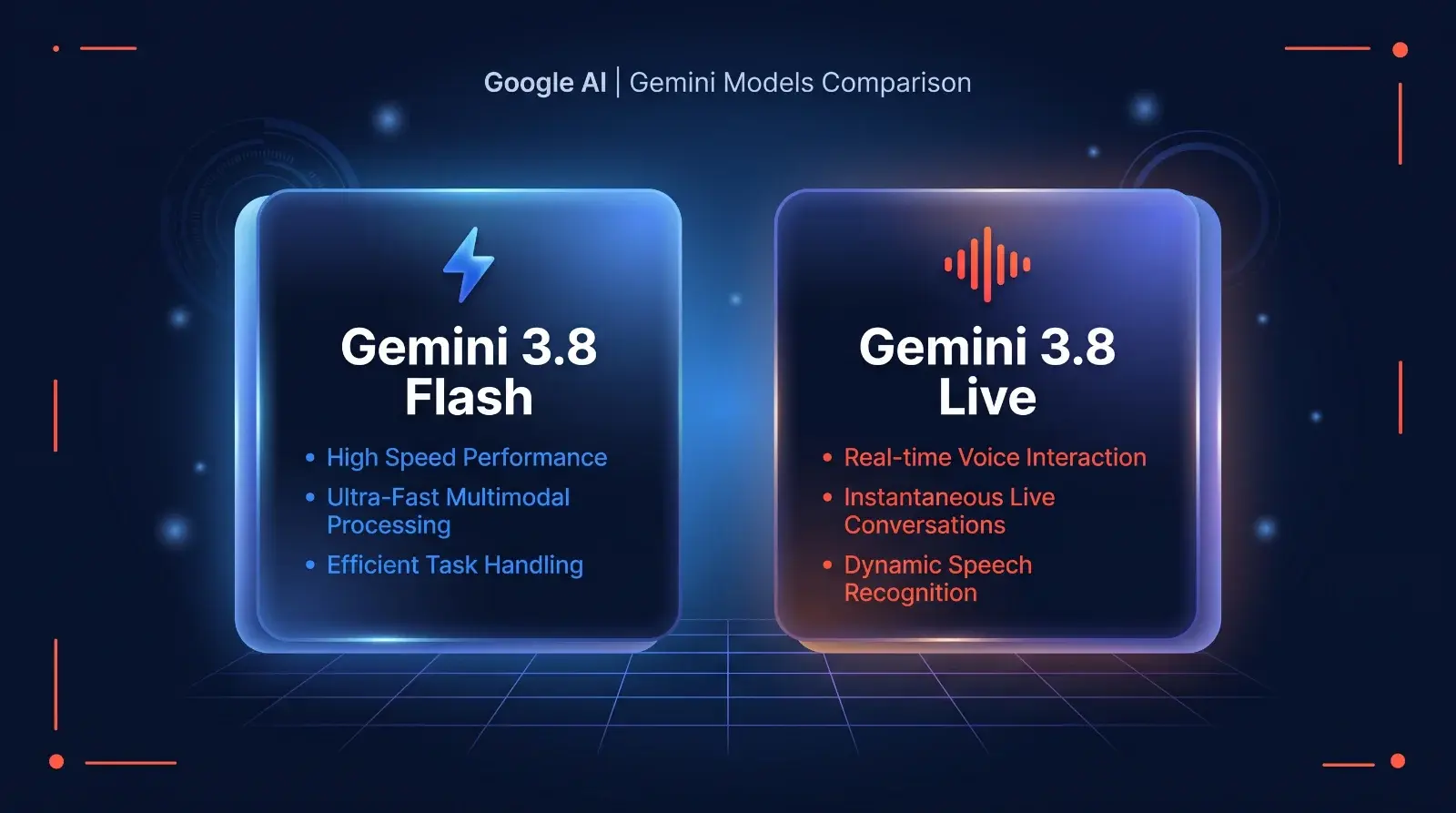
Google recently refreshed its core lineup by launching Gemini 3.8 Flash and Gemini 3.8 Live. Gemini 3.8 Flash is the latest general-availability model engineered specifically for complex reasoning, software engineering, and fast multimodal applications according to Google's official release notes. Meanwhile, Gemini 3.8 Live focuses on low-latency, natural voice conversations.
To complement the voice model, Google introduced Gemini 3.8 Live Extended Thinking. This specific feature allows the AI to perform complex background reasoning while maintaining a live audio interaction, making it highly effective for multi-step problem solving where immediate, shallow answers are insufficient.
The model breaks down a complex audio prompt into smaller logical steps, verifying its own work internally before delivering the final spoken output to the user, as detailed in the Gemini API documentation at the time of writing.
Pro Tip: If you are using the Gemini API for tasks that require high reasoning but don't need immediate text streaming, routing the request through the Extended Thinking model will yield significantly more accurate, logic-tested results than the standard Flash model.
How Do the Expanded Connected Apps and Notebook Updates Work?
The most practical capability added to the consumer and enterprise side of Gemini is the expansion of Connected Apps. Google has partnered with major third-party SaaS providers to allow Gemini to pull context directly from outside the traditional Google Workspace ecosystem.
The newly supported services include Adobe, Airtable, Linear, monday.com, PandaDoc, Zoho, Squarespace, and Webflow. This makes it easier to work with diverse services, mirroring how creators manage AI models working alongside Adobe services.
- ✓ Third-Party Retrieval: Users can now ask Gemini to summarize a project board in monday.com or pull specific records from an Airtable database without leaving the chat interface.
- ✓ Windows Desktop App: Google released a native Gemini application for Windows, allowing PC users to access these connected apps and AI tools directly from their desktop environment without opening a browser.
- ✓ Notebook Enhancements: Gemini Notebook now includes interactive learning overviews, real-time conversations, lecture recording, and automated quizzes and flashcards to support deep research workflows.
- ✓ Developer CLI Tools: The Gemini CLI received updates preventing cleartext credential leakage by enforcing HTTPS and adding a codebase investigator subagent for workspace exploration.
This cross-platform approach means a marketing team could theoretically ask Gemini to pull a campaign brief from a Google Doc, cross-reference it with task statuses in monday.com, and generate a performance report based on data residing in Zoho.
Google Gemini vs ChatGPT: How Does the Ecosystem Compare Now?
With the google gemini latest updates, the platform continues to differentiate itself from OpenAI's offerings primarily through deep enterprise integrations rather than just standalone model intelligence.
| Attribute | Google Gemini | ChatGPT |
|---|---|---|
| Developer Tools | Gemini API, Google AI Studio | OpenAI API |
| Voice Capabilities | Gemini 3.8 Live with Extended Thinking | Advanced Voice Mode |
| Third-Party Integrations | Google Workspace plus Airtable, Zoho, monday.com | OpenAI ecosystem and custom GPTs |
| Desktop Access | Native Windows App and Web | Mac and Windows Apps |
| Language Support | Supports numerous regional languages including Malayalam | Broad global language support |
Features based on official documentation at the time of writing — check each site for current capabilities.
Our analysis: If your organization heavily relies on Google Workspace combined with tools like Zoho or Airtable, Gemini's expanded connected apps make it the superior choice for reducing data-entry friction. The ability to natively pull data across these services saves countless hours of manual transferring. However, if you rely entirely on isolated, custom-built AI applications, both ecosystems offer highly competitive APIs where OpenAI often shines in niche coding tasks.
Myth: Gemini 4 Pro was released silently alongside the 3.8 models and is available for enterprise users.
Reality: Despite widespread online discussions, Google has not officially confirmed a public release, API model, pricing, or launch date for Gemini 4 Pro at the time of writing.
What Are the Known Limitations of the Latest Updates?
The new updates introduce powerful tools, but they carry standard generative AI risks alongside new privacy considerations. Connecting third-party databases to a central AI agent is inherently risky if permissions are mismanaged.
- ✓ Privacy and Permissions: Connected tools require users to grant Gemini access to third-party accounts, introducing privacy and security considerations that must be reviewed carefully by IT administrators.
- ✓ Inaccurate Information: Despite the addition of Extended Thinking, Gemini AI can still produce inaccurate information or hallucinate facts during complex research.
- ✓ Account Variability: The availability of certain Connected Apps, models, and features varies drastically depending on the user's region, account type, and product tier.
- ✓ Gemini 4 Pro Absence: There is no official API model, pricing, or release date for Gemini 4 Pro at the time of writing, leaving some power users waiting for a true next-generation leap.
The Bottom Line on Google Gemini's Latest Updates
The latest updates solidify Google Gemini as a highly practical tool for integrated workflows. Choose the new Gemini 3.8 Flash model if you are a developer building fast, agentic software. Look toward the Connected Apps feature if you are a professional wanting to query your Airtable or monday.com data directly through a chat interface.
While it is disappointing that Gemini 4 Pro remains unconfirmed, the introduction of Extended Thinking and a native Windows app makes the current 3.8 lineup exceptionally capable for daily enterprise and educational use. Explore more platform breakdowns across Tech News and our homepage to keep up with rapid AI ecosystem releases.
How We Researched This: We analyzed Google's official Gemini AI update logs, API release notes, and product availability documentation to verify these feature claims.
FAQ
Q1: What is Gemini 3.8 Flash?
A1: Gemini 3.8 Flash is Google's latest general-availability AI model designed for complex reasoning, software engineering, agentic workflows, and multimodal applications.
Q2: Does Google Gemini have a Windows app?
A2: Yes, as of September 2026, the Gemini app is officially available for Windows, allowing users to access AI features directly from their desktop without needing a web browser.
Q3: Which third-party apps connect to Google Gemini?
A3: Google recently expanded Gemini Connected Apps to include services like Adobe, Airtable, Linear, monday.com, PandaDoc, Zoho, Squarespace, and Webflow, though availability varies by account.
Q4: What is Gemini 3.8 Live Extended Thinking?
A4: Gemini 3.8 Live Extended Thinking is a feature that allows the AI to perform complex, multi-step background reasoning during natural voice conversations, improving accuracy for difficult problems.
Q5: Is Gemini 4 Pro available yet?
A5: No, Google has not officially confirmed a public release, API model, pricing, or launch date for Gemini 4 Pro at the time of writing.
Q6: What updates were made to Gemini Notebook?
A6: Gemini Notebook introduced new learning features including real-time conversations, lecture recording, interactive learning overviews, quizzes, and flashcards designed for research workflows.

Comments (0)
No comments yet. Be the first!
Leave a Comment